
Norwegian salmon exports fall 5% as Middle East war reshapes global flow
Norwegian Seafood Council April 2026 data shows the world's largest farmed salmon exporter losing volume simultaneously across multiple markets as Hormuz freight costs, US tariff uncertainty, and a stronger krone reshape directional flow.
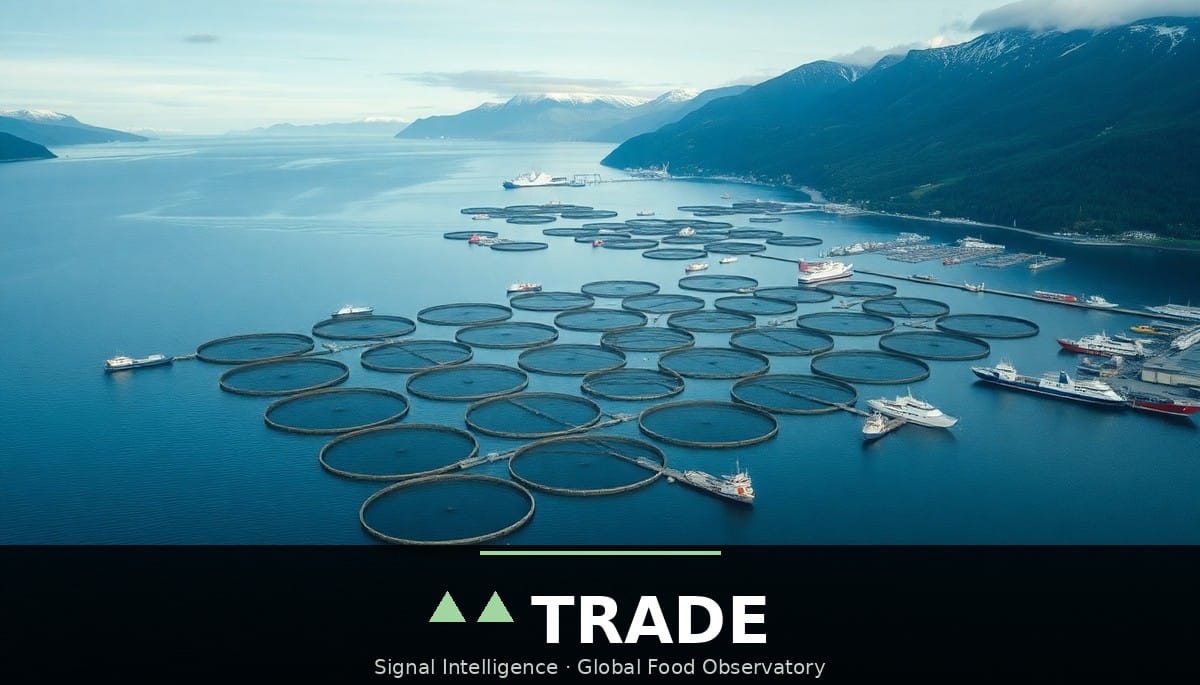
▲▲ TRADE — Signal Intelligence · Global Food Observatory
Norway exported seafood valued at NOK 13.4 billion (USD 1.44 billion) in April 2026, a 5% decline versus April 2025 (NOK 742 million lower), the Norwegian Seafood Council reported on 6 May 2026. The headline figure understates the underlying trade redirection: in dollar terms, the drop is smaller because of the krone's appreciation against the dollar and euro through the period.
NSC CEO Christian Chramer attributed the decline to two primary factors: krone appreciation, and the war in the Middle East's effect on salmon and trout flows. "The war in the Middle East is having a particular impact on the flow of salmon and trout, with higher transport costs, reduced shipping capacity and reduced tourism. Exports fell to all markets in the Middle East in April, as well as to a number of Asian markets" (Chramer, NSC, 6 May 2026).
Country-level moves are sharper than the aggregate. Norwegian seafood exports to the United States fell 30% by value in April to NOK 973 million; YTD US exports are down 32% (NOK 2 billion lower). Japan salmon exports fell 33%, Israel -36%, Vietnam -24%. On the opposite trajectory, China salmon export value rose 36% YoY in April, with volumes up 24% to 16,217 metric tonnes (NSC, 6 May 2026; SeafoodSource, 6 May 2026).
NSC analyst Paul Aandahl identified the US displacement mechanism: higher freight costs, customs duties, and a weaker dollar have caused salmon exports to shift toward Asian markets. China is now Norway's fastest-growing salmon market by value. The week-20 (11–17 May) data shows fresh whole salmon volumes from Norway softening week-on-week but remaining above year-ago levels (Undercurrent News, 20 May 2026).
Salmon prices remain under downward pressure. The average fresh whole salmon price in April was NOK 84.60/kg, 29% below April 2025 (NSC, 6 May 2026), partially driven by supply growth in Norway and other European producers. The weak-price plus redirecting-flow combination is structurally reshaping market access priorities for Norwegian operators.
This is the first month-level evidence that Middle East conflict transmission into seafood trade is now persistent rather than transitory.
Get AI-powered analysis of this signal — implications, risks, and procurement actions tailored to your exposure.