
Britain loses bird-flu freedom as H5 reaches Washington dairy herds
H5N5 on the Isle of Lewis ended Great Britain's self-declared bird-flu freedom. USDA also confirmed H5 in two Washington dairy herds, the state's first livestock detections.
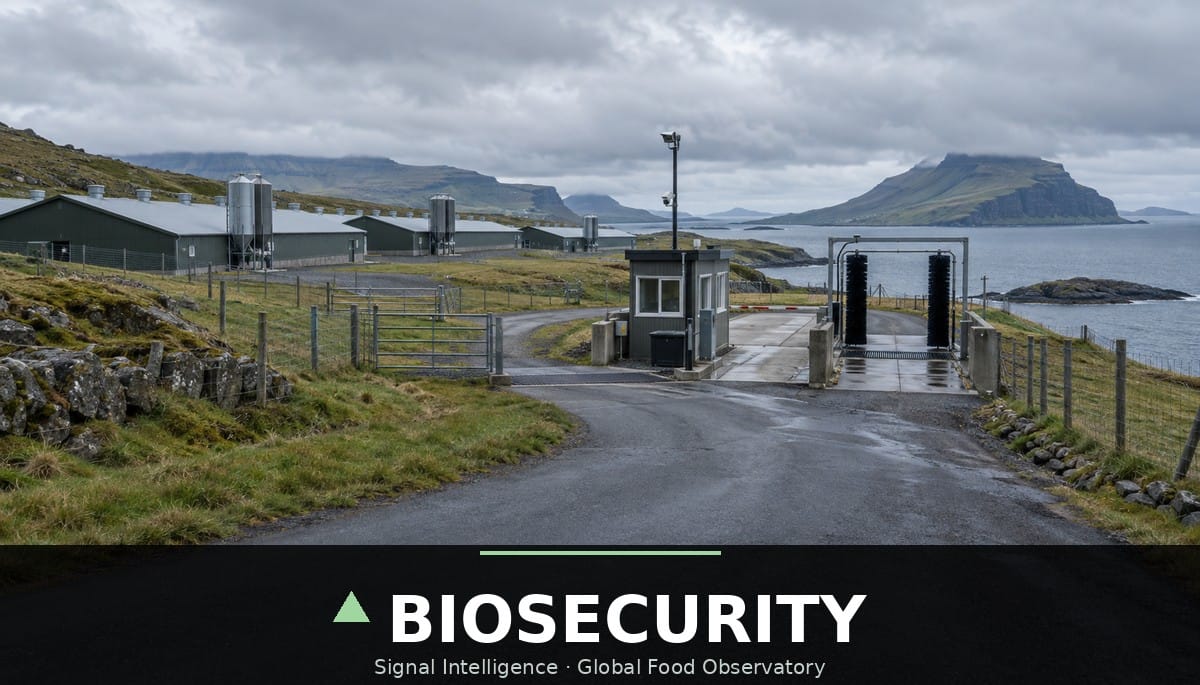
▲ BIOSECURITY — Signal Intelligence · Global Food Observatory
H5N5 on the Isle of Lewis ended Great Britain's self-declared bird-flu freedom. USDA also confirmed H5 in two Washington dairy herds, the state's first livestock detections.
Overview
HPAI H5N5 was confirmed at premises in Ness on the Isle of Lewis on 2 October, with 3 km protection and 10 km surveillance zones. Defra states that this first outbreak of the 2026/27 season means Great Britain has lost its self-declared HPAI freedom (Scottish Government; Defra).
The trade effect depends on each partner's import rules and acceptance of regionalisation. Great Britain's status should not be conflated with Northern Ireland's, and a first outbreak does not automatically determine access for the entire winter.
In the United States, USDA confirmed HPAI H5 clade 2.3.4.4b in two Washington dairy herds on 8 October, the state's first confirmed livestock detections. Genetic sequencing was still in progress; the announcement should not be presented as confirmation of a specific H5N1 genotype (USDA APHIS).
USDA says the commercial pasteurised milk supply remains safe. These detections are a surveillance and market-access signal, not evidence of a national dairy supply disruption (USDA APHIS).
Evidence
- H5N5 confirmed at Ness on 2 October; 3 km and 10 km zones applied (Scottish Government).
- Great Britain's self-declared HPAI freedom lost (Defra).
- Two Washington dairy herds positive for H5 clade 2.3.4.4b; sequencing in progress (USDA APHIS).
- Commercial pasteurised milk supply remains safe (USDA APHIS).
Market implications
Poultry exporters should confirm which partner markets accept regionalisation and which impose wider restrictions. Importers can diversify winter sourcing across eligible origins, while monitoring recovery timelines and changes to partner rules. US dairy ingredient buyers should monitor surveillance and any new trading-partner testing requirements rather than assume a supply shock.