
USDA cuts Indonesian palm oil output by 2.2 million tonnes
USDA cuts its 2026/27 Indonesian palm oil forecast to 45 million tonnes as NOAA confirms rainfall suppression. Forward supply risk is increasing, but the forecast is not a measured harvest loss.
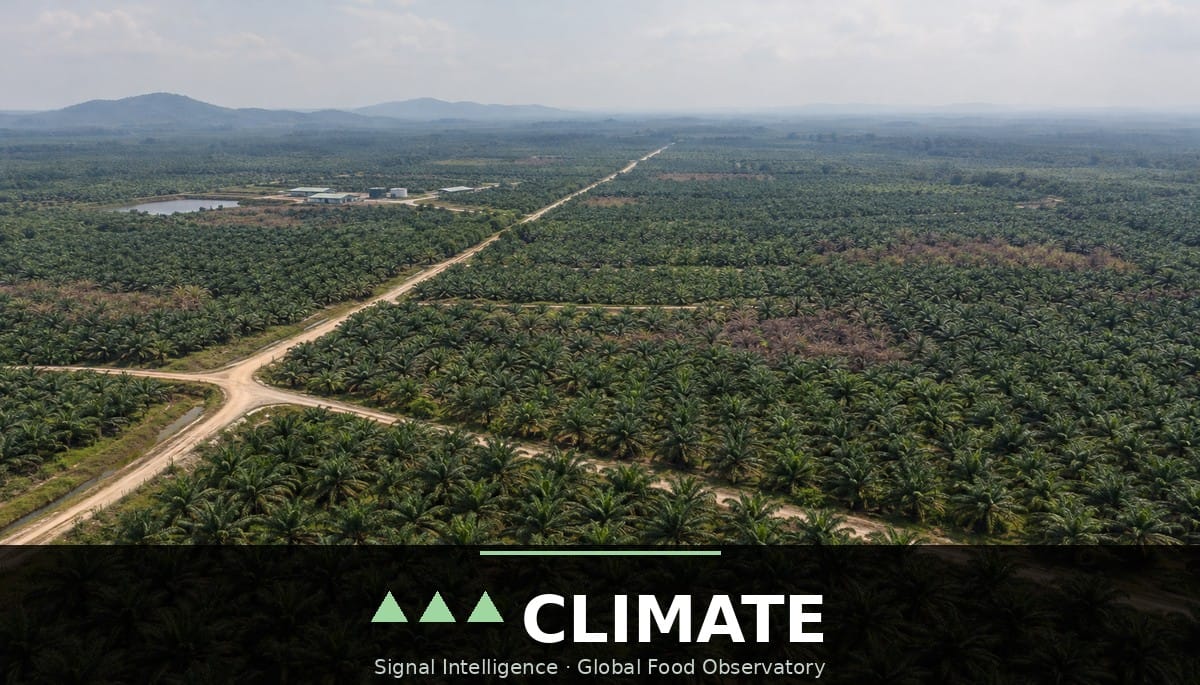
▲▲▲ CLIMATE — Signal Intelligence · Global Food Observatory
USDA cuts its 2026/27 Indonesian palm oil forecast to 45 million tonnes as NOAA confirms rainfall suppression. Forward supply risk is increasing, but the forecast is not a measured harvest loss.
Overview
El Niño risk is now reflected in USDA's official 2026/27 palm oil production forecast. USDA lowered Indonesia's 2026/27 palm oil production by 2.2 million tonnes to 45 million, citing dry weather over the past several months lowering crop prospects ahead (USDA, 9 October 2026). It now projects global palm oil production 2.5 million tonnes below the prior marketing year, with global stocks at their lowest since 2017/18 (USDA, 9 October 2026).
The physical evidence arrived the day before. NOAA reported Niño-3.4 at +2.1°C, Niño-3 at +3.0°C and Niño-1+2 at +3.9°C, with convection and rainfall suppressed over Indonesia (NOAA CPC, 8 October 2026). CPC puts an 83% chance on the October-December relative index reaching +2.5°C or more, which would exceed every El Niño on record since 1950 (NOAA CPC, 8 October 2026).
The wording of USDA's cut matters. Palm is a tree crop, and USDA ties the reduction to dry weather already experienced lowering prospects ahead. The forecast reduction concerns the coming marketing year; it is not a confirmed measurement of harvest losses. That is why the cut flows through to the aggregate: world vegetable oil production for 2026/27 falls to 243.16 million tonnes from 245.36 million a month earlier, and ending stocks to 29.92 million tonnes from 30.80 million (USDA, 9 October 2026).
Evidence
- Indonesia 2026/27 palm oil production cut 2.2 million tonnes to 45.0 million on dry weather; global palm oil stocks projected lowest since 2017/18 (USDA, 9 October 2026).
- World vegetable oil production 2026/27 lowered to 243.16 million tonnes from 245.36 million; ending stocks lowered to 29.92 million tonnes from 30.80 million (USDA, 9 October 2026).
- Niño-3.4 at +2.1°C, Niño-1+2 at +3.9°C; convection and rainfall suppressed over Indonesia (NOAA CPC, 8 October 2026).
- 83% chance that October-December 2026 exceeds every El Niño since 1950; strong-to-very-strong event likely through January-March 2027 at greater than 83% (NOAA CPC, 8 October 2026).
Market implications
Vegetable oil buyers should separate spot availability from forward supply risk and stress-test 2027 cover against USDA's lower Indonesian forecast. Competing soybean, sunflower and rapeseed oils could attract substitution demand if palm availability tightens. Malaysian inventories and Indonesian biodiesel policy remain important counterweights; neither the timing nor the size of substitution is settled.