
Namibia turns to FMD vaccination, complicating export recovery
Namibia's Karasburg outbreak has reached 18 farms and compulsory vaccination has begun. Recovery of disease-free status depends on the control strategy and evidence, not a universal six-month clock.
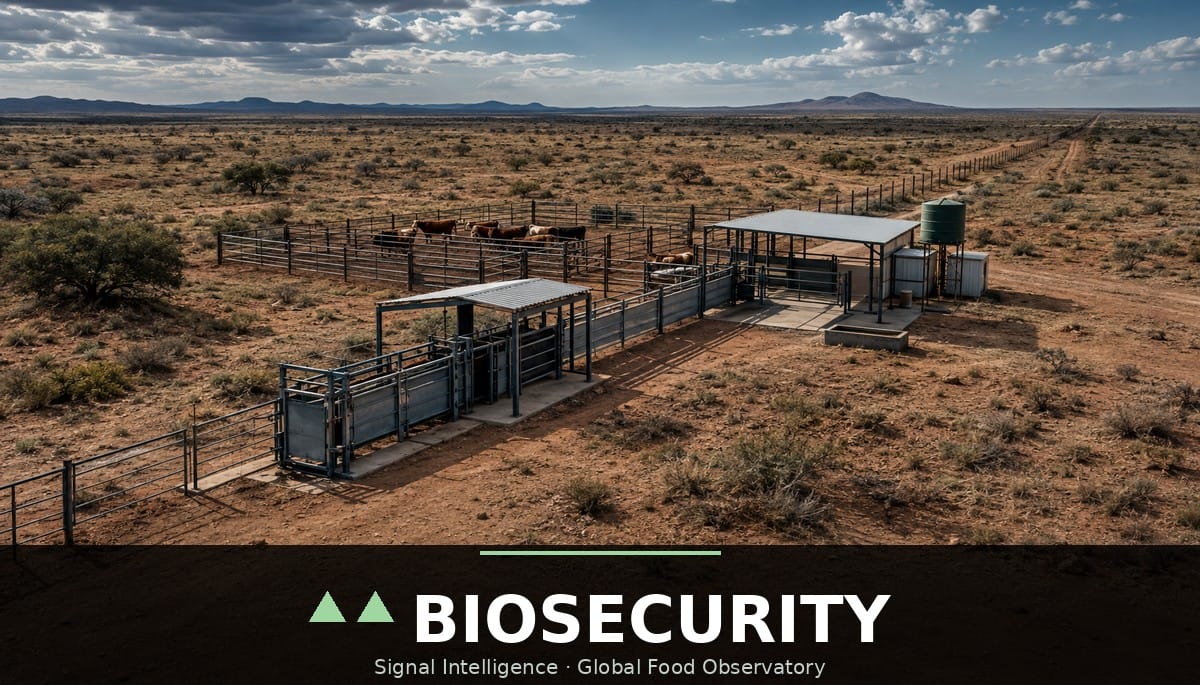
▲▲ BIOSECURITY — Signal Intelligence · Global Food Observatory
Namibia's Karasburg outbreak has reached 18 farms and compulsory vaccination has begun. Recovery of disease-free status depends on the control strategy and evidence, not a universal six-month clock.
Signal assessment
Emerging Trend. Official case figures and the vaccination programme mark a continuation of Editions 31 and 32. The new angle is the control strategy; recovery timing cannot be inferred from vaccination alone.
Overview
Namibia's agriculture ministry reported 131 SAT1-positive animals across 18 infected farms in the Karasburg State Veterinary District, after 63,011 animals had been inspected. The ministry said the southern outbreak and the separate Kalala Island outbreak in Zambezi were not epidemiologically linked (The Brief, 14 October 2026).
Compulsory vaccination began on 14 October, with three rounds planned over three months. The programme is a disease-control intervention, not a reopening timetable (Xinhua via Ghana News Agency, 15 October 2026).
The recovery rules are conditional. WOAH's 2024 Code describes a six-month route where stamping-out and emergency vaccination are used and not all vaccinated animals are slaughtered, subject to surveillance and evidence of no transmission; sufficient evidence can permit a shorter period. If all vaccinated animals are slaughtered, a different route applies (WOAH, Article 8.8.11).
Crucially, the Code says those waiting periods do not apply where stamping-out is not practised. Namibia's minister had said on 8 October that the government would not cull affected cattle and would pursue vaccination; the precise applicable recovery route must therefore be confirmed rather than assumed (WOAH) (The Namibian, 8 October 2026).
GFO does not assign a fixed mid-2027 reopening floor. Official status recovery requires accepted evidence, and commercial access also depends on the affected zone, commodity and importing partner's requirements; it should not be equated with a blanket national beef-export ban (WOAH).
Evidence
- 131 SAT1 positives across 18 farms; 63,011 animals inspected (The Brief).
- Compulsory vaccination began 14 October, with three rounds over three months (Xinhua via Ghana News Agency).
- Southern and Zambezi outbreaks reported as unrelated (The Brief).
- WOAH recovery conditions differ with stamping-out, vaccination, slaughter and surveillance evidence (WOAH, Article 8.8.11).
Market implications
GFO analysis: Importers should establish which zones and products remain eligible in each destination market, then qualify replacement supply where needed. Alternative beef exporters can seek contracts without presenting Namibia's absence as permanent or assigning an unsupported end date. Veterinary agencies should confirm the relevant WOAH route and partner requirements before promising a reopening schedule.