
Brazil's soybean area faces its slowest expansion in 20 years as growth shifts north
Conab forecasts soybean area up just 1.4% to 49.3 million hectares, with gains concentrated in northern and northeastern states. Output is projected up only 0.7%, implying a slightly lower average yield.
▲ SUPPLY — Signal Intelligence · Global Food Observatory
Conab forecasts soybean area up just 1.4% to 49.3 million hectares, with gains concentrated in northern and northeastern states. Output is projected up only 0.7%, implying a slightly lower average yield.
Signal assessment
Early Signal. The central area and output estimates come from Conab's first survey, with regional and historical detail reported by The AgriBiz. Planting and seasonal weather remain unresolved; this is not a measured crop loss.
Signal
Brazil's first 2026/27 crop survey forecasts soybean planting across 49.3 million hectares, 1.4% more than the previous season. Output is projected at a record 181.6 million tonnes, up 0.7%. These are forward estimates, not a harvested crop (Conab, 15 October).
The AgriBiz reports that this would be the slowest area expansion in 20 years, and the weakest since the 2006/07 contraction. It attributes the slowdown to tighter margins, cautious investment and weather uncertainty, rather than an outright national retreat from soybeans (The AgriBiz, 15 October).
The marginal hectares matter. The report places growth in northern and northeastern regions, particularly Rondônia, Tocantins, Piauí and Maranhão, while Center-West soybean acreage is expected to remain broadly unchanged. It identifies those expansion states as potentially exposed to a stronger El Niño, not as already experiencing a quantified yield loss (The AgriBiz).
The arithmetic corrects a misleading reading of the headline. With area up 1.4% and production up 0.7%, implied average yield is approximately 0.7% lower: the ratio of 1.007 to 1.014, minus one. That is GFO's calculation from Conab's rounded growth rates. The forecast production gain is area-supported, not yield-led (Conab).
There is competition for investment across crops. The AgriBiz reports an 11% projected rise in first-crop corn area to about 4.5 million hectares, encouraged by corn-ethanol demand. This does not mean every extra corn hectare displaces soybeans, especially where sequential cropping is involved (The AgriBiz).
The survey's soybean progress figures describe the beginning of October, when 15.6% of projected area had been sown. They should not be relabelled as current late-October progress, and different private and official planting trackers should not be spliced into one series (Conab).
Read alongside the trade signal, the supply questions are distinct: Chinese purchases affect US-origin execution, while Brazilian 2027 availability depends on final area, weather and realised yield. Neither a record forecast nor a narrow area increase secures exportable supply.
Evidence
- Soybean area: 49.3 Mha, +1.4%; production: 181.6 Mt, +0.7% (Conab).
- Projected area growth is the slowest in 20 years, according to reporting of Conab's historical data (The AgriBiz).
- Growth concentrated in northern/northeastern states; Center-West broadly unchanged (The AgriBiz).
- First-crop corn area projected up about 11% to 4.5 Mha (The AgriBiz).
Implication
GFO analysis: Soybean and meal buyers should test procurement against a range of Brazilian yields rather than assume larger area guarantees much larger supply. Monitor rainfall in the expansion states alongside the much larger established producing regions. Conab and other forecasters may use different area and yield assumptions, so quote each forecast with its date and method instead of treating a private estimate as an interchangeable upper bound.
Edition 35 · Week commencing 26 October 2026 · Research checked 26 October 2026.
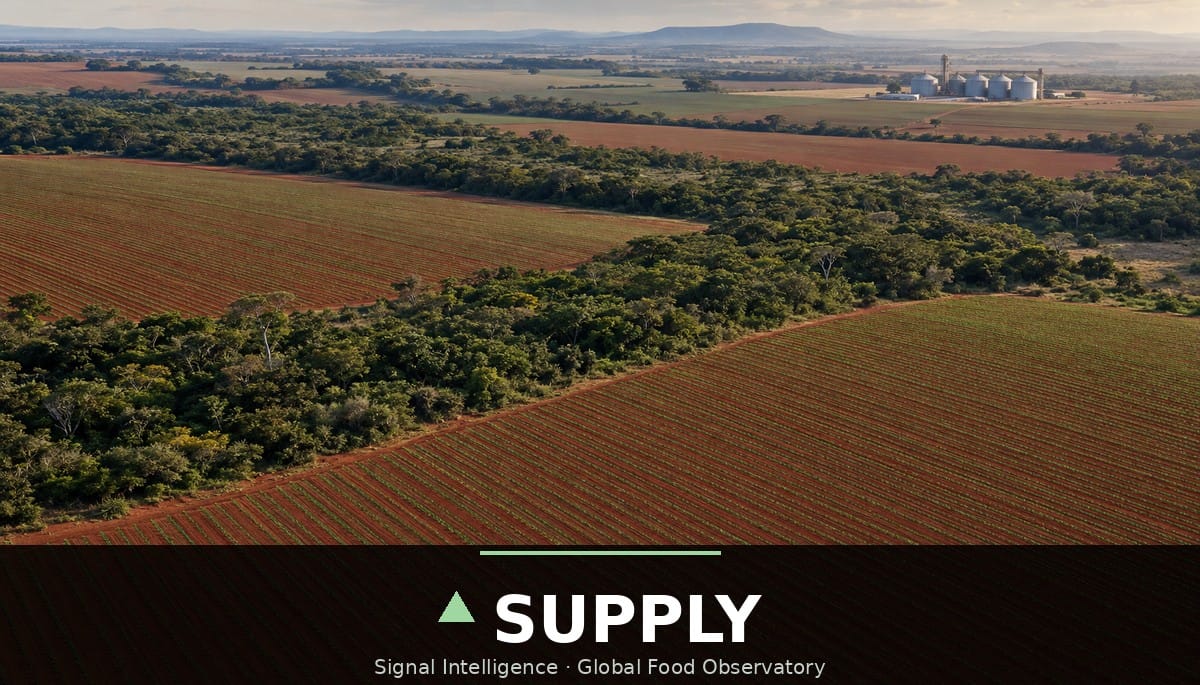
Feature image: AI-generated editorial illustration, not a photograph of a reported event.
Should 2027 soybean and meal procurement be based on Conab's estimate or a higher alternative forecast?
Conab's November survey; observed rainfall in Matopiba and Rondônia; planting progress using a consistent series; first-crop corn area.
Conab's November output stays below 182 million tonnes while rainfall in northern expansion states is below normal. Use this as a scenario-review trigger, not proof of a national shortage.
November to January.