
Southern Africa's maize planting season opens under El Niño as forecasters converge on drought risk
GEOGLAM and FEWS NET forecast a hotter, drier 2026/27 growing season across much of southern Africa. Strong 2026 harvests provide a near-term buffer, while the larger supply risk falls on the 2027 crop.
▲▲ CLIMATE — Signal Intelligence · Global Food Observatory
GEOGLAM and FEWS NET forecast a hotter, drier 2026/27 growing season across much of southern Africa. Strong 2026 harvests provide a near-term buffer, while the larger supply risk falls on the 2027 crop.
Signal assessment
Emerging Trend. Two institutional assessments and the regional SARCOF outlook align on elevated risk. They draw on overlapping climate evidence, and seasonal probabilities are not a measured crop loss or a guarantee of uniformly dry conditions.
Signal
GEOGLAM's 16 October special report expects below-average rainfall across much of southern Africa during October 2026 to March 2027. The report describes an established, strengthening El Niño expected to persist into 2027, with elevated risk during the main cropping season (GEOGLAM, 16 October).
SARCOF-33 favours below-normal October–December rainfall in southern Angola, southern Zambia, Zimbabwe, southern Malawi, central and southern Mozambique, Namibia, Botswana and most of South Africa. Multi-model guidance gives 40–50% probabilities of below-normal rainfall across much of the central and southern belt. These are probabilities of a rainfall category, not expected percentage crop losses (GEOGLAM).
Heat compounds establishment risk. GEOGLAM reports greater than 70% probability of temperatures above the 90th percentile for the November–April growing season. Its near-surface soil-moisture outlook places several major agricultural areas in the driest third of historical forecasts for November–January (GEOGLAM).
FEWS NET's October assessment also expects delayed onset, prolonged dry spells and above-average temperatures. It stresses the importance of December–February rainfall for maize and distinguishes the 2027 harvest impact from the later peak in acute food insecurity, potentially during the November 2027–March 2028 lean season (FEWS NET, October special report).
The region is not entering this risk period without a buffer. South Africa's September supply-and-demand report, published on 2 October, uses a CEC commercial maize estimate of 17.523 million tonnes, above the August figure cited in the scan, and projects substantial closing stocks. These are forecast balances, not a guarantee that every importing country can access affordable supplies (NAMC, 2 October).
The geographic exceptions matter. Northern Zambia, northern Malawi and northern Mozambique are among areas forecast normal to above normal; short periods of heavy rain can also occur within a season expected to be dry overall. Observed onset and crop establishment should therefore guide decisions alongside the seasonal outlook (GEOGLAM).
Evidence
- Seasonal dry-risk outlook spans October 2026 to March 2027 (GEOGLAM).
- Multi-model below-normal rainfall probabilities: 40–50% in much of the central/southern belt (GEOGLAM).
- FEWS NET identifies delayed onset, dry spells and heat as risks to the 2027 maize crop (FEWS NET).
- Updated South African CEC maize estimate in the September balance: 17.523 Mt (NAMC).
Implication
GFO analysis: Southern African buyers have time to review forward cover while the 2026 harvest buffer remains available. Extending cover into H2 2027 is a risk-management option, not proof that waiting will necessarily cost more. Exporters can prepare higher-import-demand scenarios if rainfall deficits materialise, while food manufacturers should test costs and logistics against drought and more favourable rainfall outcomes.
Edition 35 · Week commencing 26 October 2026 · Research checked 26 October 2026.
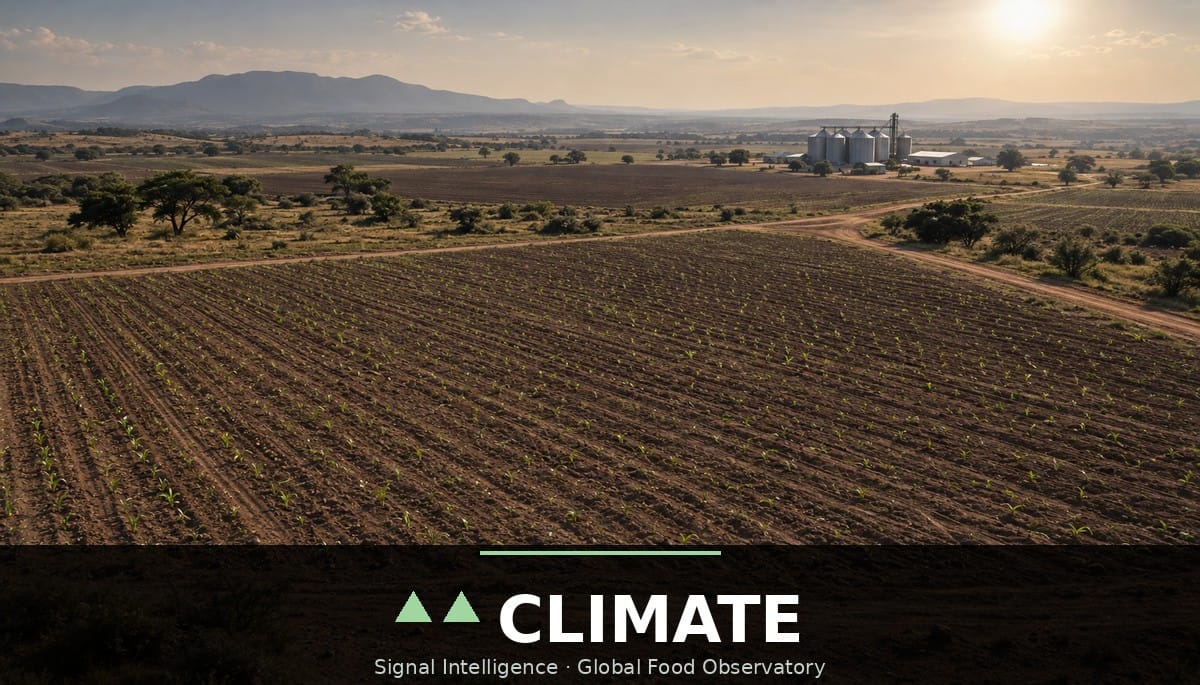
Feature image: AI-generated editorial illustration, not a photograph of a reported event.
Should southern African buyers extend maize forward cover into H2 2027?
Observed November rainfall onset; South African planting intentions; planted-area reports; December–January dry spells and soil moisture.
Planting rains remain delayed into late November across a material part of the central and southern maize belt, and field evidence confirms poor establishment.
November to January, with procurement implications into H2 2027.