
Peru's anchovy closure tightens fishmeal supply
PRODUCE has withheld the north-central second season after a survey found high juvenile prevalence and anomalously warm water. The decision does not close every Peruvian fishery or establish a firm 2027 reopening date.
▲▲ CLIMATE — Signal Intelligence · Global Food Observatory
PRODUCE has withheld the north-central second season after a survey found high juvenile prevalence and anomalously warm water. The decision does not close every Peruvian fishery or establish a firm 2027 reopening date.
Signal assessment
Emerging Trend. A confirmed ministry decision, IMARPE survey and NOAA ocean conditions support a material supply risk. El Niño closures are cyclical, so this is not rated a Structural Shift.
Signal
Peru's production ministry has not authorised the second anchovy season in the north-central zone, the main industrial fishery. The decision is specific to that management zone, not a closure of every Peruvian anchovy fishery (PRODUCE, 16 October).
The official account cites IMARPE's scientific cruise 2609-10, with data to 7 October. Acoustic biomass was about 5.12 million tonnes, 27.9% below the summer survey and 22.8% below the 1996–2025 winter-spring average (PRODUCE and IMARPE).
Juveniles represented 79% of the surveyed population by number and 65% by weight. These are different measures: the numerical share is not the percentage of biomass unavailable for processing or a direct forecast of fishmeal output (PRODUCE and IMARPE).
IMARPE found anomalously warm conditions, with anchovy concentrated nearer the coast, shifted south and swimming deeper. Scientific monitoring continues rather than a guaranteed reopening date being specified (PRODUCE).
NOAA's 8 October ENSO discussion reports the Niño-1+2 index reaching +3.9°C in the preceding month and a greater-than-83% likelihood of strong-to-very-strong El Niño through January–March 2027. That probability concerns event strength, not a probability that the fishery stays closed throughout the period (NOAA CPC).
The closure removes an important prospective seasonal source of fishmeal and fish oil, but inventory, other fisheries, trimmings and substitution affect the downstream gap. Industry reporting confirms the cancellation; no current institutional fishmeal-price benchmark was verified for this edition (SeafoodSource, 16 October).
Our read: H1 2027 availability merits attention now, but neither a shortage lasting until a fixed date nor a guaranteed first-season reopening can be inferred. The next scientific assessment and ministry decision remain decisive.
Evidence
- North-central second anchovy season not authorised (PRODUCE).
- Survey biomass: 5.12 Mt; -27.9% versus summer, -22.8% versus the historical winter-spring average (PRODUCE/IMARPE).
- Juveniles: 79% by number, 65% by weight (PRODUCE/IMARPE).
- Niño-1+2 reached +3.9°C in the preceding month; next discussion scheduled for 12 November (NOAA CPC).
Implication
GFO analysis: Aquafeed, starter-feed and omega-3 buyers should assess H1 cover, stocks and supplier exposure to Peru's north-central season. Test feasible substitutions early, with nutrition, quality and regulatory limits explicit. Diversification should compare genuinely independent fisheries and trimmings sources, rather than assume all marine ingredients share the same ocean risk or complete protection from it.
Edition 36 · Week commencing 2 November 2026 · Research checked 1 November 2026.
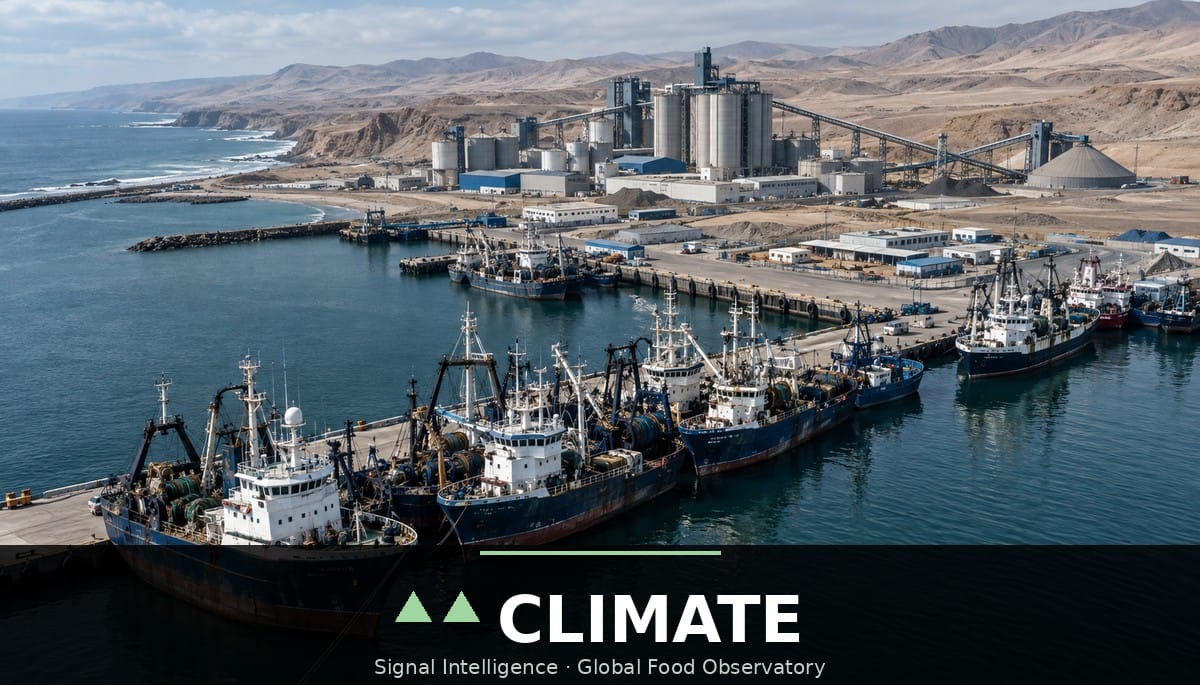
Feature image: AI-generated editorial illustration, not a photograph of a reported event.
Aquafeed and compound-feed formulators; fish-oil and omega-3 buyers; marine-ingredient traders.
NOAA's 12 November ENSO discussion; PRODUCE notices on the north-central fishery; IMARPE stock, juvenile and ocean-condition assessments.
Now for H1 2027 procurement and reformulation trials. Do not assume a reopening date until a formal decision and usable supply are established.