
El Niño threatens Asia's dry-season rice
Philippine drought and early Mekong salinity threaten dry-season rice. FAO forecasts the first global production decline in four seasons, but stocks remain high.
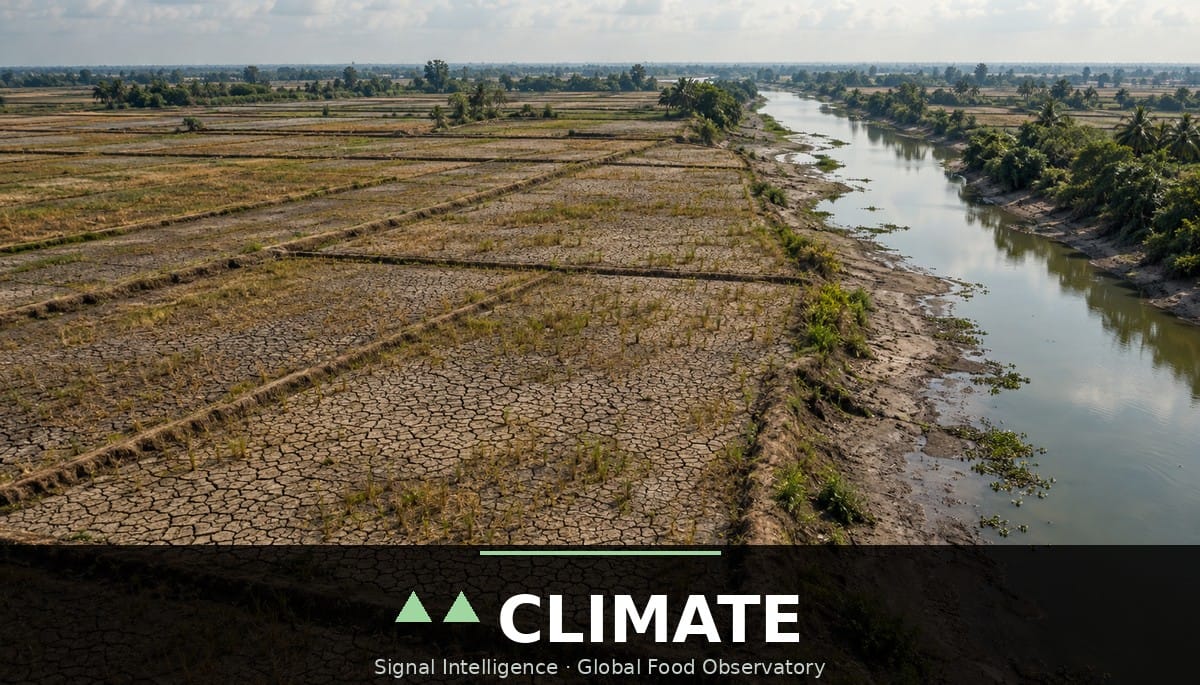
▲▲ CLIMATE — Signal Intelligence · Global Food Observatory
Philippine drought and early Mekong salinity threaten dry-season rice. FAO forecasts the first global production decline in four seasons, but stocks remain high.
Signal Strength
National meteorological and agriculture authorities in two major rice economies have issued specific forward warnings, consistent with FAO's new forecast of the first global rice production fall in four seasons. Rated Emerging Trend: the risk window is identified and dated, but crop losses are not yet measured.
Signal
The El Niño story for rice is moving from the crop now being harvested to the one about to be planted.
The Philippine weather agency PAGASA says El Niño has reached very strong intensity, will peak before the end of 2026, and is likely to affect conditions into the first half of 2027 (Manila Bulletin, El Niño reaches very strong intensity; peak likely before year-end, PAGASA, 5 November 2026). Five provinces experienced meteorological drought in October, with 11 more under dry spell conditions (FAO, 6 November 2026).
Vietnam is preparing for an early and deep dry season. Its Ministry of Agriculture and Environment has warned that Mekong Delta saltwater intrusion could begin as early as December, reaching 10 to 20 kilometres further inland than the multi-year average, and that river inflows this dry season could be among the lowest on record (Tuoi Tre News, Very strong El Nino to bring early saltwater intrusion to southern Vietnam from December, 17 October 2026). The Mekong Delta's winter-spring crop is planted in this window.
FAO's global numbers set the context. World rice production is forecast to fall 2.5% to 552.0 million tonnes, the first contraction in four seasons, on poor margins and El Niño weather, while rice utilisation of 558.8 million tonnes exceeds output (FAO, Cereal Supply and Demand Brief, 6 November 2026). The FAO All Rice Price Index rose 1.6% in October (FAO, 6 November 2026).
The buffer is real. FAO expects global rice stocks to fall but to remain at 216.5 million tonnes, the second-highest on record (FAO, Cereal Supply and Demand Brief, 6 November 2026). For now this looks like a price and timing risk for importers rather than a shortage.
PAGASA's own 4 November release confirms the five drought provinces, eleven under dry spell and ten under dry conditions. It also warns that heavy rain can still occur during tropical cyclones: the outlook is a risk assessment, not a measured dry-season rice loss (PAGASA, 4 November).
Evidence
- PAGASA reported 5 provinces in meteorological drought, 11 in dry spell and 10 under dry conditions in October 2026 (Manila Bulletin, citing PAGASA, 5 November 2026).
- Vietnam's ministry forecasts Mekong salinity intrusion 10 to 20 kilometres beyond the multi-year average, starting as early as December 2026 (Tuoi Tre News, citing the Ministry of Agriculture and Environment, 17 October 2026).
- India's weather office expects very strong El Niño conditions through November and December, with below-normal November rainfall over South Peninsular India (India Meteorological Department, Monthly Outlook for Rainfall and Temperature for November 2026, 31 October 2026).
- FAO expects El Niño impacts on production to remain severe into 2027 in several subregions (FAO, Crop Prospects and Food Situation, November 2026, release of 6 November 2026).
Implication
Rice importers in Southeast Asia, West Africa and the Middle East should look at their first-half 2027 coverage now, because the crop at risk is the one that normally supplies that period. Earlier coverage can reduce exposure if weather losses materialise, but it does not guarantee a lower purchase price. Exporters with large public stocks, India first among them, will have pricing power if dry-season losses materialise, and their export policy becomes the main variable for buyers. Food companies using rice as an ingredient should check whether contracts specify origin, since a Vietnam-specific shortfall can be bridged by other origins at a premium.
Sources
PAGASA, 4 November; Tuoi Tre, 17 October; FAO cereal balance, 6 November; FAO price indices, 6 November.
Feature image: AI-generated editorial illustration, not a photograph of a reported event.
extend rice import cover into Q2 2027.
supply depends on Vietnamese or Thai dry-season crops.
supply is contracted from India or Pakistan on fixed terms.
NOAA CPC ENSO update; Vietnam dry-season salinity bulletins from December; PAGASA drought assessment for November.