
Philippines orders a 60-day pork import curb
Department Order 33 restricts nine pork import lines. The commencement rule must be checked before treating the pause as active, while higher tariffs remain a proposal.
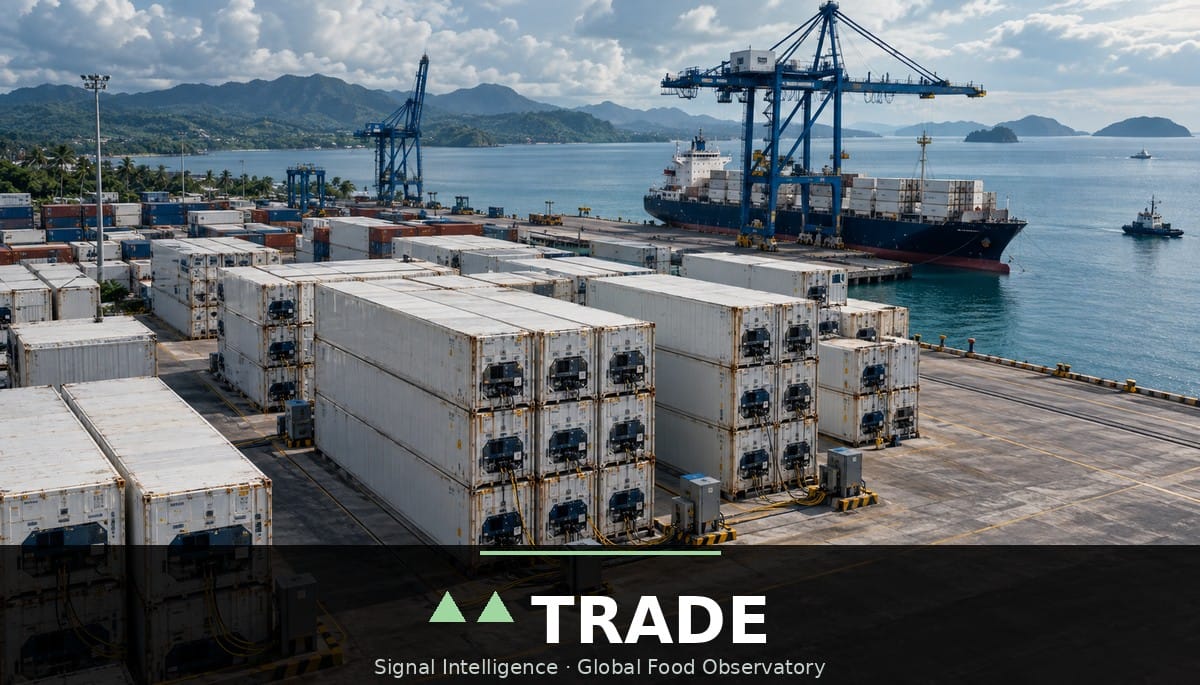
▲▲ TRADE — Signal Intelligence · Global Food Observatory
Department Order 33 restricts nine pork import lines. The commencement rule must be checked before treating the pause as active, while higher tariffs remain a proposal.
Signal Strength
A confirmed, signed measure by one of the largest pork importing markets, reported consistently by four Philippine outlets citing the Department of Agriculture. Rated Emerging Trend rather than Structural Shift because the restriction is provisional, its start date is not yet fixed, and the longer-term remedy (tariff increases) depends on a Tariff Commission investigation that has not concluded.
Signal
The Philippines has ordered a 60-day restriction on a defined set of pork imports. The order should not be treated as already effective without checking its commencement and customs implementation rules.
Agriculture Secretary Francisco Tiu Laurel Jr. signed Department Order 33, dated 7 November, imposing a quantitative restriction on nine pork cut varieties as a provisional safeguard (The Philippine Star, Department of Agriculture bans imported pork cuts, 9 November 2026). Coverage includes fresh, chilled and frozen carcasses and half-carcasses, bone-in hams and shoulders, and edible offal including liver (BusinessMirror, PHL bans pork imports for 60 days; hams included, 9 November 2026).
The trigger is farm economics. The Department of Agriculture puts pork imports at 836,240 tonnes in 2025, up 42% from 589,675 tonnes in 2023, and estimates hog industry losses of P27.9 billion in the first seven months of 2026 (Daily Tribune, Hog industry bleeds P27.9B amid import surge, 9 November 2026). Average farmgate prices fell to P175.75 per kilogram in the first half from P198.30 in 2025 (FAO, 6 November 2026).
The start date is open. The order takes effect on a Bureau of Customs order or 15 days after publication in two newspapers, whichever comes first (Manila Bulletin, Philippines imposes 60-day pork import ban, 9 November 2026). Tiu Laurel said there is room to extend it by up to a further 140 days, and that the country holds roughly 170 days of pork stock (Rappler, Pork import ban too little too late?, 9 November 2026).
The second step matters more than the first. The department wants in-quota pork tariffs raised to 30% from 15% and out-of-quota tariffs to 40% from 25%, and the case now goes to the Tariff Commission for a formal investigation (Daily Tribune, 9 November 2026). The United States, the United Kingdom and Canada have already filed position papers opposing higher tariffs (Manila Bulletin, US, UK, Canada urge Philippines to stop proposed pork tariff increase, 28 October 2026).
Our read: the 60-day restriction is a holding action. The durable change, if it comes, will be the tariff schedule.
The official department-order register dates DO 33 to 7 November (Department of Agriculture). The Philippine News Agency reports 24 November as the publication-based effective date; BusinessMirror also records the alternative, earlier customs-order trigger (PNA, 9 November) (BusinessMirror, 9 November).
Evidence
- Brazil supplied 284,127 tonnes, or 47% of Philippine pork imports, in January to August 2026 (Bureau of Animal Industry data, reported in Manila Bulletin, 28 October 2026).
- The Philippines was Brazil's largest pork destination in 2025, taking 25.3% of its exports (USDA data, reported in eFeedLink, Philippines takes top spot as Brazil's biggest market for pork in 2025, 13 March 2026).
- USDA FAS Manila estimated 2026 Philippine pork imports at 780,000 tonnes carcass weight equivalent and forecast a further 7.1% rise in 2027, before this measure (USDA FAS, Livestock and Products Annual, Manila, RP2026-0022, September 2026).
- Pork self-sufficiency fell to 54% in January to August 2026 from 74.3% in 2021, and frozen pork inventories reached 121,000 tonnes in July, 94% of it imported (Department of Agriculture, cited in Daily Tribune, 9 November 2026).
Implication
Exporters with Philippine exposure should treat product already contracted for December and January arrival as at risk until the customs order fixes the start date, and check whether sanitary import clearances already issued will be honoured. Offal sellers are most exposed, because the Philippines is an outlet for cuts that have few alternative buyers at similar prices. Brazil carries the largest volume risk, which means competing pork exporters in other Asian markets should expect Brazilian product looking for a home over the next two months. Traders and processors should also price the tariff case separately: a move to 30% and 40% duties would change landed-cost rankings between origins for longer than any 60-day pause.
Sources
Department of Agriculture order register; BusinessMirror; Philippine Star; Rappler; Philippine News Agency.
Feature image: AI-generated editorial illustration, not a photograph of a reported event.
hold, divert or renegotiate Philippine-bound pork shipments for December to February.
cargo is unshipped and destined for one of the nine restricted lines.
product falls outside the restricted lines or arrives after the 60-day window on current timing.
Bureau of Customs implementing order; Tariff Commission investigation schedule.