
Kansas Hard Red Winter Wheat Faces 31% Production Collapse as May WASDE Opens First 2026/27 Global Balance Sheet
A drought-driven yield failure in the US Southern Plains has pushed Kansas HRW production to a projected 31% decline from trendline, with the May 12 WASDE set to crystallise the damage in the first official 2026/27 global supply estimate.
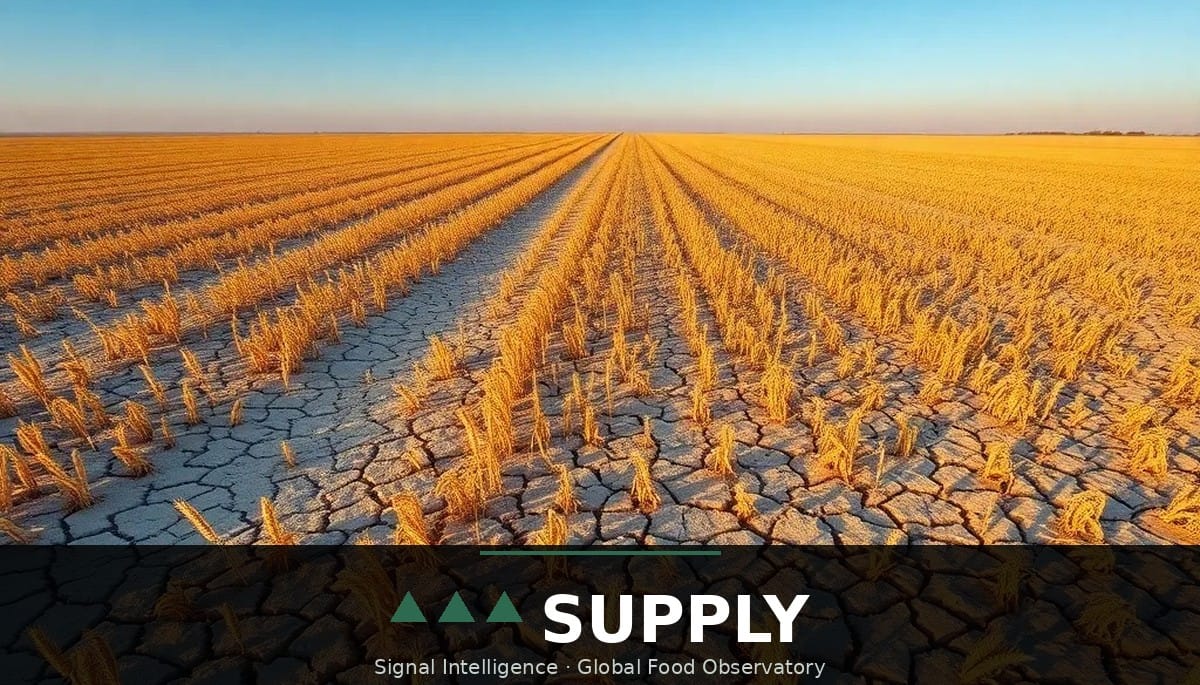
A drought-driven yield failure in the US Southern Plains has pushed Kansas HRW production to a projected 31% decline from trendline, with the May 12 WASDE set to crystallise the damage in the first official 2026/27 global supply estimate.
Signal
The 2026 US Hard Red Winter wheat harvest is tracking toward one of the most significant single-season production failures in recent Plains history. Drought across Kansas, Nebraska, and Oklahoma has advanced through the critical jointing and heading stages without meaningful rainfall relief, locking in yield losses that agronomists now describe as partially irreversible.
Kansas State University economist Gregg Ibendahl's production model projects Kansas yield at 39.4 bushels per acre against a trendline expectation of 44.2 bushels per acre — a 11% yield gap that, applied to planted area, translates to a harvest of approximately 240 million bushels, a 31% year-on-year production decline (Pro Farmer, Kansas 2026 HRW Wheat Forecast, April 2026). Ninety percent of Nebraska and Oklahoma remain in drought conditions (USDA, cited in TradingEconomics.com, May 2026), and agronomist Mike Tannura has assessed the May rainfall forecast as "nothing substantial," with June precipitation arriving too late for optimal yield recovery (Pro Farmer, April 2026).
KC HRW futures responded by reaching near two-year highs of $6.53 per bushel on 4 May 2026, before pulling back on geopolitical noise (TradingEconomics.com, May 2026). The pullback does not reflect crop recovery — it reflects external demand-side uncertainty. The physical supply picture has not improved.
The May 12 WASDE release will publish the first USDA estimates for the 2026/27 marketing year, covering global wheat production, trade, and ending stocks. Market participants are pricing in downward pressure on world HRW supply estimates, and the inaugural balance sheet will anchor price expectations for the remainder of the season (DTN Pro Farmer, May 8, 2026).
Evidence
- Kansas State University economist Gregg Ibendahl projects Kansas HRW yield at 39.4 bu/acre vs. 44.2 bu/acre trendline, with harvest at ~240 million bushels — a 31% year-on-year decline (Pro Farmer, Kansas 2026 HRW Wheat Forecast, April 2026)
- USDA NASS good-to-excellent crop ratings: 24% as of 19 April 2026, down from 32% the prior week and 62% in November 2025 (USDA NASS, Weekly Crop Progress, April 2026)
- 90% of Nebraska and Oklahoma cropland in drought conditions as of May 2026 (USDA, cited in TradingEconomics.com, May 2026)
- KC HRW futures hit near two-year highs of $6.53/bu on 4 May 2026; agronomist Tannura assesses May rainfall forecast as "nothing substantial" (Pro Farmer, April 2026; TradingEconomics.com, May 2026)
Implication
Import-dependent markets in North Africa, the Middle East, and Southeast Asia that source HRW for milling and blending should treat the May 12 WASDE as a pricing inflection point rather than a routine data release. Procurement teams holding back on forward cover in anticipation of price weakness should reassess that posture: the physical damage in Kansas is largely set, and the WASDE will confirm rather than correct market expectations. For traders and millers sourcing HRW-adjacent specifications — including Australian hard wheat and Argentine bread wheat — origin substitution pressure will intensify across the May–August tender window. Food companies with flour-based product lines and commodity pass-through exposure should flag this as a margin management priority for H2 2026.
Sources: Pro Farmer, Kansas 2026 HRW Wheat Forecast, April 2026; USDA NASS, Weekly Crop Progress, April 2026; TradingEconomics.com citing USDA, May 2026; DTN Pro Farmer, May 8, 2026.
Get AI-powered analysis of this signal — implications, risks, and procurement actions tailored to your exposure.