EU Deforestation Regulation Delayed and Weakened Again as April Compliance Review Approaches
EUDR postponed twice and scope narrowed, with April 2026 simplification review potentially altering due diligence requirements for soy, beef, cocoa and coffee supply chains.

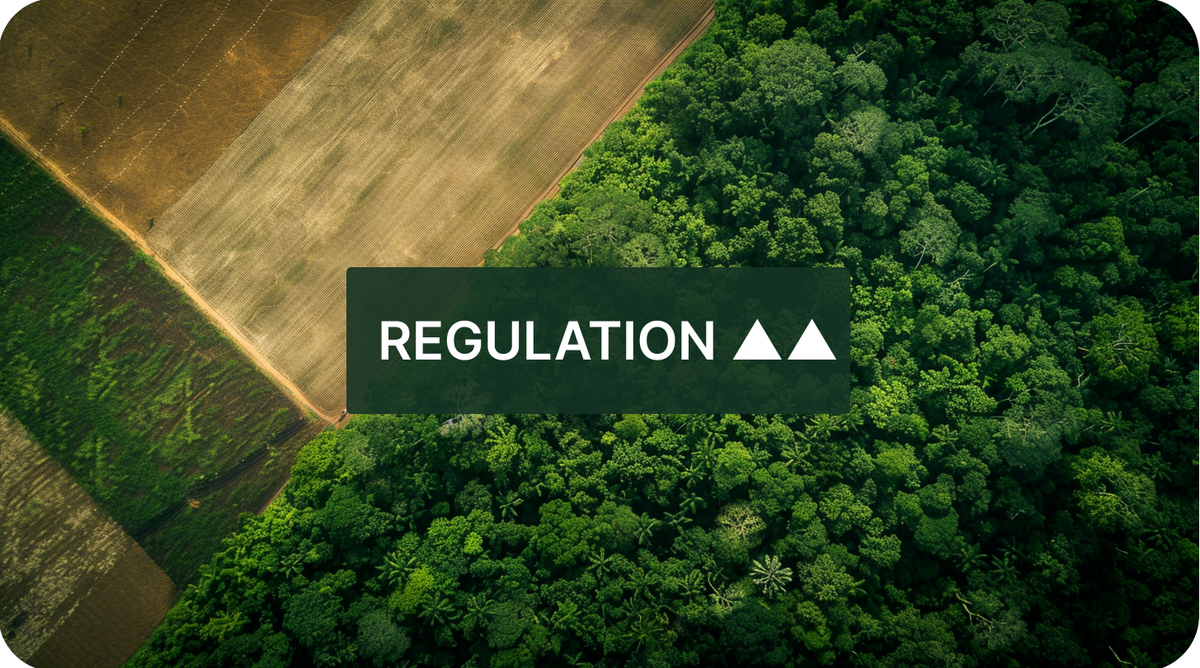
The EUDR has been postponed for the second time in twelve months, its downstream obligations substantially reduced - and a mandatory Commission review due by 30 April 2026 may reopen the core text before it has ever been enforced.
The EUDR's repeated delay and progressive weakening is itself the signal. A regulation that passed with near-unanimous support in 2023 has been deferred twice, narrowed in scope, and now faces a mandatory legislative review before it has applied to a single shipment. For commodity supply chains — soy, beef, palm oil, cocoa, coffee, timber — the compliance deadline remains operative, but the enforcement architecture is materially weaker than originally designed. The April review is the next inflection point.
SIGNAL
Under Regulation (EU) 2025/2650, published in the EU Official Journal on 23 December 2025, the EU Deforestation Regulation has been delayed for the second consecutive year. Large and medium operators now face a compliance deadline of 30 December 2026. Micro and small operators have until 30 June 2027. The revision — driven by a centre-right and far-right majority in the European Parliament — also significantly reduced the obligations of downstream operators and traders. Under the revised rules, only the first operator to place a relevant product on the EU market must submit a full due diligence statement; downstream actors — manufacturers, processors, retailers — face substantially reduced requirements. The European Commission is mandated to publish a Simplification Review by 30 April 2026. If that review is accompanied by a legislative proposal, as the mandate allows, the core text could be reopened before the regulation has ever entered into force.
EVIDENCE
- The EUDR covers seven commodity categories: cattle, cocoa, coffee, oil palm, rubber, soya and wood — and all derived products including beef, leather, chocolate, paper and furniture (European Commission)
- The first delay (December 2024) pushed the deadline from 30 December 2024 to 30 December 2025. The second delay (December 2025) pushed it to 30 December 2026 — a two-year deferral from the original application date (EU Council)
- Under the December 2025 revision, downstream operators and traders no longer need to file independent due diligence statements; only first-to-market operators carry full traceability obligations — a change critics say creates enforcement blind spots (ClientEarth)
- Commissioner Roswall stated in January 2026 that no further core text reopening is planned; this position was reiterated at the EUDR Expert Group meeting on 10 February 2026 — but the April review clause legally permits a legislative proposal if the Commission identifies grounds (Mayer Brown)
- Environmental groups estimate the postponement delays annual prevention of 72,000 hectares of forest loss and 32 million metric tonnes of CO₂ emissions that would otherwise have been avoided from 2025 (ClientEarth)
- The EU-Mercosur interim trade agreement, now moving toward provisional application, embeds a deforestation-free clause as an essential element — meaning Mercosur commodity imports entering the EU under preferential tariffs must still satisfy EUDR requirements by end-2026 (European Commission)
IMPLICATION
The EUDR's political trajectory is weakening, but its December 2026 deadline remains legally binding — and the compliance infrastructure required to meet it takes considerably longer to build than the political timeline suggests. For importers of Brazilian soy, beef and palm oil, the interaction between the EUDR and the EU-Mercosur interim trade agreement is the most complex near-term operational challenge: preferential tariff access and deforestation-free sourcing requirements are now inseparable. Companies that invested early in traceability systems have lost the competitive compliance advantage they expected — but they have not lost the underlying obligation. The April Simplification Review is the next critical moment: if it triggers a further legislative proposal, compliance obligations for H2 2026 will remain legally uncertain through the autumn. A third delay, or material further weakening, would signal that the EUDR as originally conceived will not be the instrument that drives deforestation-free supply chain transformation — and that market-led or bilateral mechanisms will need to fill the gap.
Sources: EU Council (December 2025); European Parliament (December 2025); Mayer Brown (February 2026); ClientEarth (December 2025); EnviroLink (12 March 2026); Bird & Bird (December 2025); European Commission EUDR factsheet
EUDR enforcement delay → reduced traceability pressure on downstream EU buyers → weakened price signals for certified deforestation-free soy, beef, palm oil, cocoa, coffee from Brazil, Indonesia, Côte d'Ivoire → compliance investment uncertainty for importers, processors, and retailers across EU food and furniture supply chains.
- EU importers and first-to-market operators in soy, palm oil, and cocoa face full due diligence costs while downstream competitors escape equivalent obligations — margin compression for compliant supply chain leaders.
- Traceability technology providers and certification bodies see demand erosion as urgency fades; contracted build-outs may stall or be renegotiated.
- Brazilian and Indonesian exporters serving EU markets face continued uncertainty on whether premium deforestation-free sourcing commands price advantage or becomes stranded investment before December 2026.
- Winners: Downstream EU processors and retailers now exempt from independent due diligence; commodity traders with diversified sourcing who delayed compliance spend; exporters from low-risk countries awaiting benchmarking clarity.
- Losers: Early-mover importers who built traceability infrastructure expecting competitive differentiation; environmental certification schemes banking on regulatory-driven demand; producer-country governments that accelerated monitoring systems in anticipation of enforcement.