WTO Ministerial Opens in Yaoundé with Agriculture Deadlock Unresolved for Third Consecutive Conference
WTO MC14 convenes in Yaoundé with no agriculture consensus for the third consecutive ministerial. Bilateral deals continue to fill the gap as multilateral trade rules stall.

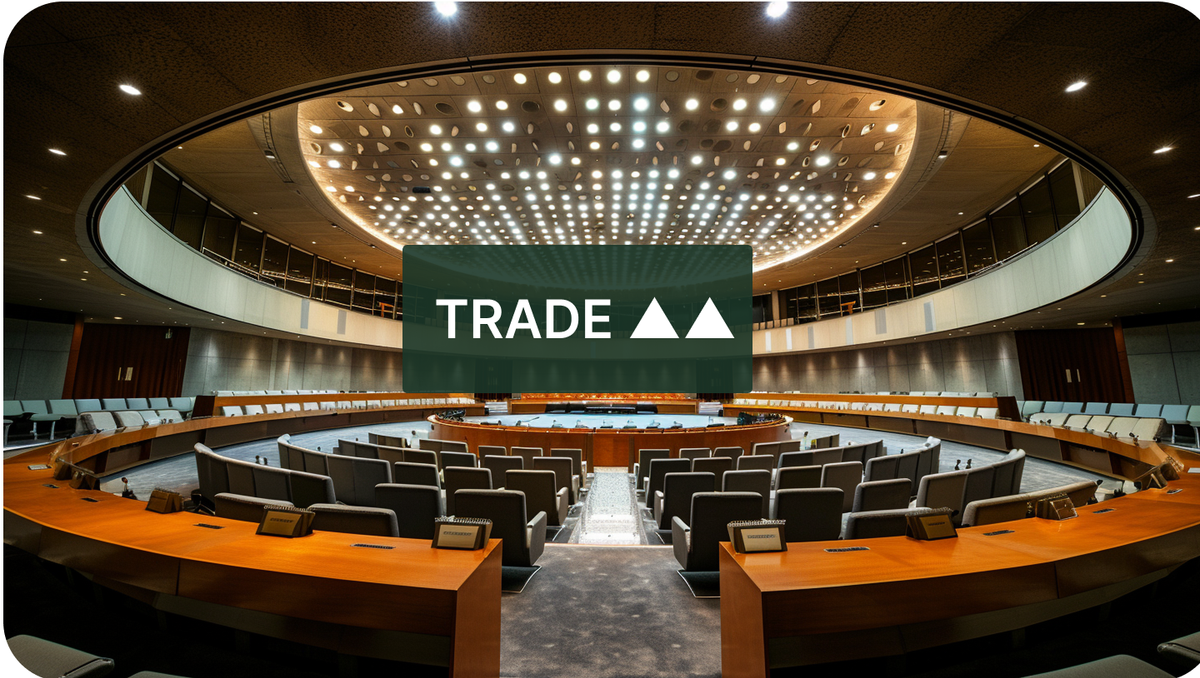
Trade ministers from 166 WTO member nations convene in Cameroon this week with no consensus text on agriculture - the central negotiating file that has stalled at every ministerial since 2022.
MC14 is unlikely to deliver binding new disciplines on agricultural trade. The more consequential signal is what a third consecutive failure would confirm: that the multilateral rules-based framework for agricultural trade is functionally stalled, and that bilateral and regional agreements — EU-Mercosur, US bilateral deals, CPTPP — are now the operative architecture through which food trade access is being negotiated. That is a structural shift with long-term implications for how market access is won and defended.
SIGNAL
The WTO's 14th Ministerial Conference opens in Yaoundé, Cameroon on 26 March 2026, running through 29 March. Agriculture is the most contested file on the agenda and the one carrying the most institutional weight — the previous Ministerial in Abu Dhabi in 2024 closed without consensus on agriculture, as did MC13 in Geneva in 2022. Seven new negotiating submissions were tabled in December 2025, with two further submissions from Indonesia and the African Group added in late January 2026. The core unresolved issues are: reduction of trade-distorting domestic support; the special safeguard mechanism (SSM) for developing economies; public stockholding programmes for food security; and disciplines on export restrictions. WTO Director-General Ngozi Okonjo-Iweala has called agriculture the file that should be "the centre of attention" at MC14, while Agriculture Negotiations Chair Ambassador Hussain of Pakistan warned that "rebuilding trust" is a prerequisite for any meaningful outcome.
EVIDENCE
- The most recent WTO Ministerial Conference (Abu Dhabi, February 2024) ended with no consensus outcome on agriculture — the second consecutive failure following Geneva 2022 (WTO)
- Seven new negotiating submissions were tabled in December 2025; a further two — from Indonesia and the African Group — were shared at the Committee on Agriculture Special Session on 30 January 2026 (WTO)
- The Cairns Group of agricultural exporting economies and the African Group have produced a joint draft modalities package setting out formulas for domestic support reduction — the most substantive convergence attempt ahead of MC14 (WTO)
- India has formally proposed a permanent solution on public stockholding for food security — a long-running unresolved issue that has blocked consensus at multiple previous ministerials (Insights on India)
- FAO published a dedicated series of Trade Policy Briefs ahead of MC14 addressing agricultural trade reform, food security, and WTO institutional questions (FAO)
- Options currently in play include: a ministerial declaration on trade, agriculture and food security; a targeted deliverables package for least-developed countries; or a post-MC14 negotiating roadmap with agreed thematic tracks (WTO)
IMPLICATION
A meaningful MC14 outcome on agriculture — even a limited one — would represent the first enforceable multilateral progress on domestic support and export restrictions since the elimination of agricultural export subsidies at MC10 in Nairobi in 2015. That matters most to commodity-exporting nations competing against heavily subsidised producers in the US and EU. For food-importing developing nations, any disciplines on export restrictions would reduce exposure to the kind of price shocks seen during the 2022 Ukraine-driven grain crisis. A repeat stalemate at MC14 would not be a neutral outcome — it would accelerate the ongoing fragmentation of agricultural trade governance into competing bilateral and regional frameworks, rewarding larger trading blocs with negotiating leverage at the expense of smaller economies and LDCs that depend on multilateral rules for market access and price stability. Watch for an agreed post-MC14 work programme as the minimum viable outcome — even without binding commitments, an agreed negotiating roadmap frames the regulatory trajectory for domestic support reform across 2026–2028.
Sources: WTO (multiple, November 2025 – February 2026); WFO-OMA MC14 Briefing (March 2026); FAO Trade Policy Briefs (March 2026); Insights on India (March 2026)
WTO agricultural negotiation failure → accelerated shift to bilateral/regional trade frameworks (EU-Mercosur, CPTPP, US deals) → large trading blocs gain preferential access while LDCs and smaller exporters face eroding MFN terms → commodity flow patterns restructure around bloc membership rather than multilateral rules.
- Agricultural exporters outside major trading blocs (African producers, smaller Cairns Group members) face widening tariff disadvantages as preferential bilateral deals multiply, compressing margins on bulk commodities.
- Food-importing developing economies remain exposed to unrestricted export bans during future supply shocks—no new disciplines mean 2022-style price spikes remain structurally possible.
- Multinational grain traders and processors with cross-bloc operations gain flexibility; those concentrated in single-bloc supply chains face growing market access asymmetry.
- Winners: EU and Mercosur agricultural sectors (pending deal ratification), CPTPP members with diversified export portfolios, large trading houses able to arbitrage fragmented rule sets.
- Losers: Least-developed country exporters dependent on multilateral MFN access, US and EU competitors facing continued subsidy-driven market distortion without new disciplines, net food importers without bilateral hedges against export restrictions.